3Module 3 — Decision Tree Analysis & Partial Dependence
3.1 Learning Outcomes
By the end of this module learners will be able to:
Explain how decision trees split data (Gini, entropy) and the difference between classification and regression trees.
Fit, visualize, prune, and evaluate decision tree models in R (rpart, rpart.plot).
Use cross-validation and caret for tuning and model selection.
Interpret model predictions using feature importance and Partial Dependence Plots (PDPs) with pdp, iml, and DALEX.
Write tests that validate model behavior on simple datasets.
3.2 1. Setup & packages
3.3 2. Decision tree basics (intuition)
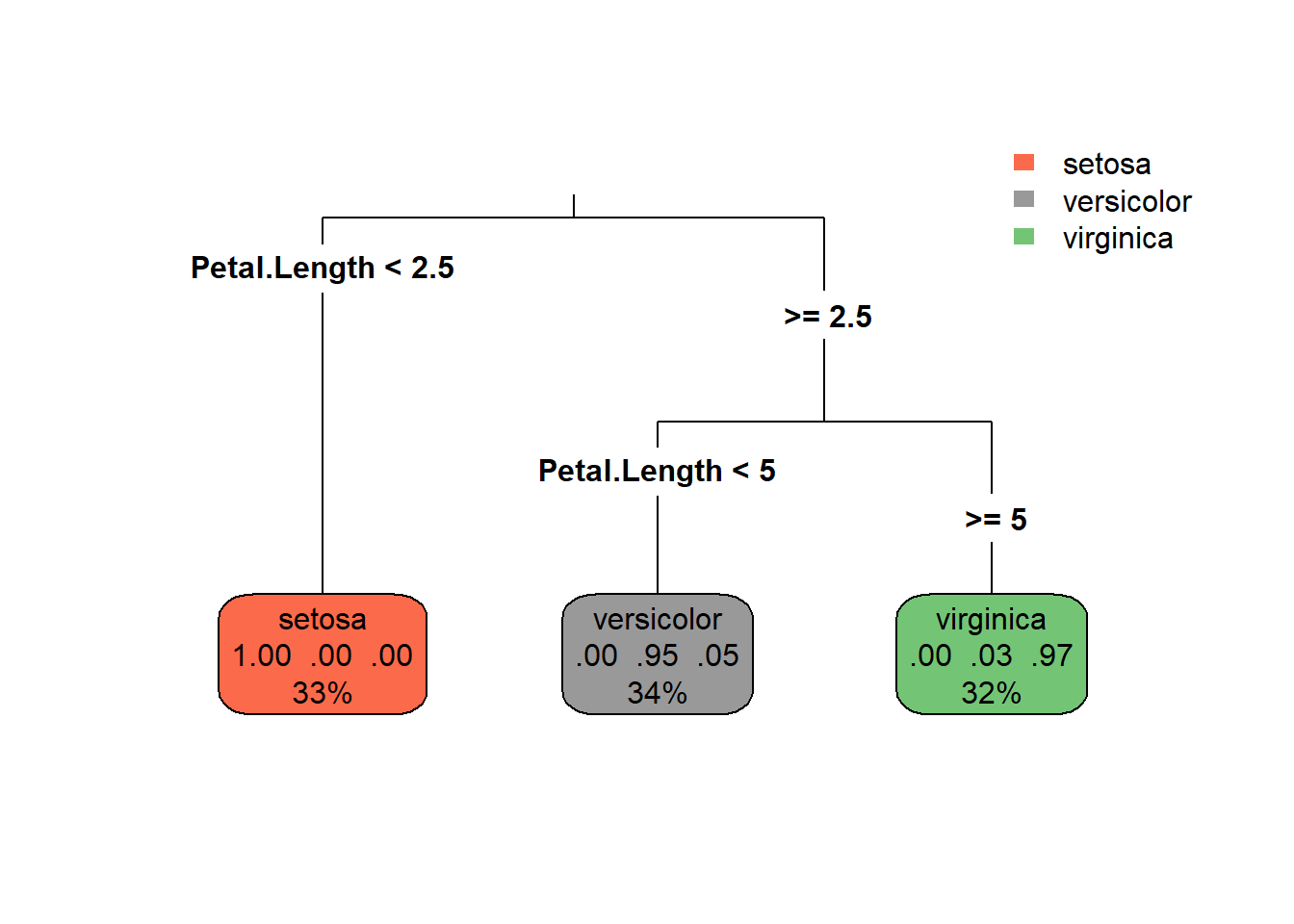
Short summary: trees recursively split the feature space to create homogeneous groups. Splits are chosen to maximize reduction in impurity (Gini or entropy for classification; MSE for regression).
3.4 3. Building a classification tree (code-along)
# Use the iris dataset and create a reproducible train/test splitdata(iris)train_idx <-createDataPartition(iris$Species, p =0.75, list =FALSE)train <- iris[train_idx, ]test <- iris[-train_idx, ]# Fit a simple rpart treefit_rpart <-rpart(Species ~ ., data = train, method ="class", control =rpart.control(cp =0.01))# Visualize the treerpart.plot(fit_rpart, type =3, extra =104, fallen.leaves =TRUE)
# Predict and evaluatepred_class <-predict(fit_rpart, test, type ="class")cm <-confusionMatrix(pred_class, test$Species)cm
Confusion Matrix and Statistics

            Reference
Prediction   setosa versicolor virginica
  setosa         12          0         0
  versicolor      0         11         4
  virginica       0          1         8

Overall Statistics

               Accuracy : 0.8611
                 95% CI : (0.705, 0.9533)
    No Information Rate : 0.3333
    P-Value [Acc > NIR] : 8.705e-11

                  Kappa : 0.7917

 Mcnemar's Test P-Value : NA

Statistics by Class:

                     Class: setosa Class: versicolor Class: virginica
Sensitivity                 1.0000            0.9167           0.6667
Specificity                 1.0000            0.8333           0.9583
Pos Pred Value              1.0000            0.7333           0.8889
Neg Pred Value              1.0000            0.9524           0.8519
Prevalence                  0.3333            0.3333           0.3333
Detection Rate              0.3333            0.3056           0.2222
Detection Prevalence        0.3333            0.4167           0.2500
Balanced Accuracy           1.0000            0.8750           0.8125
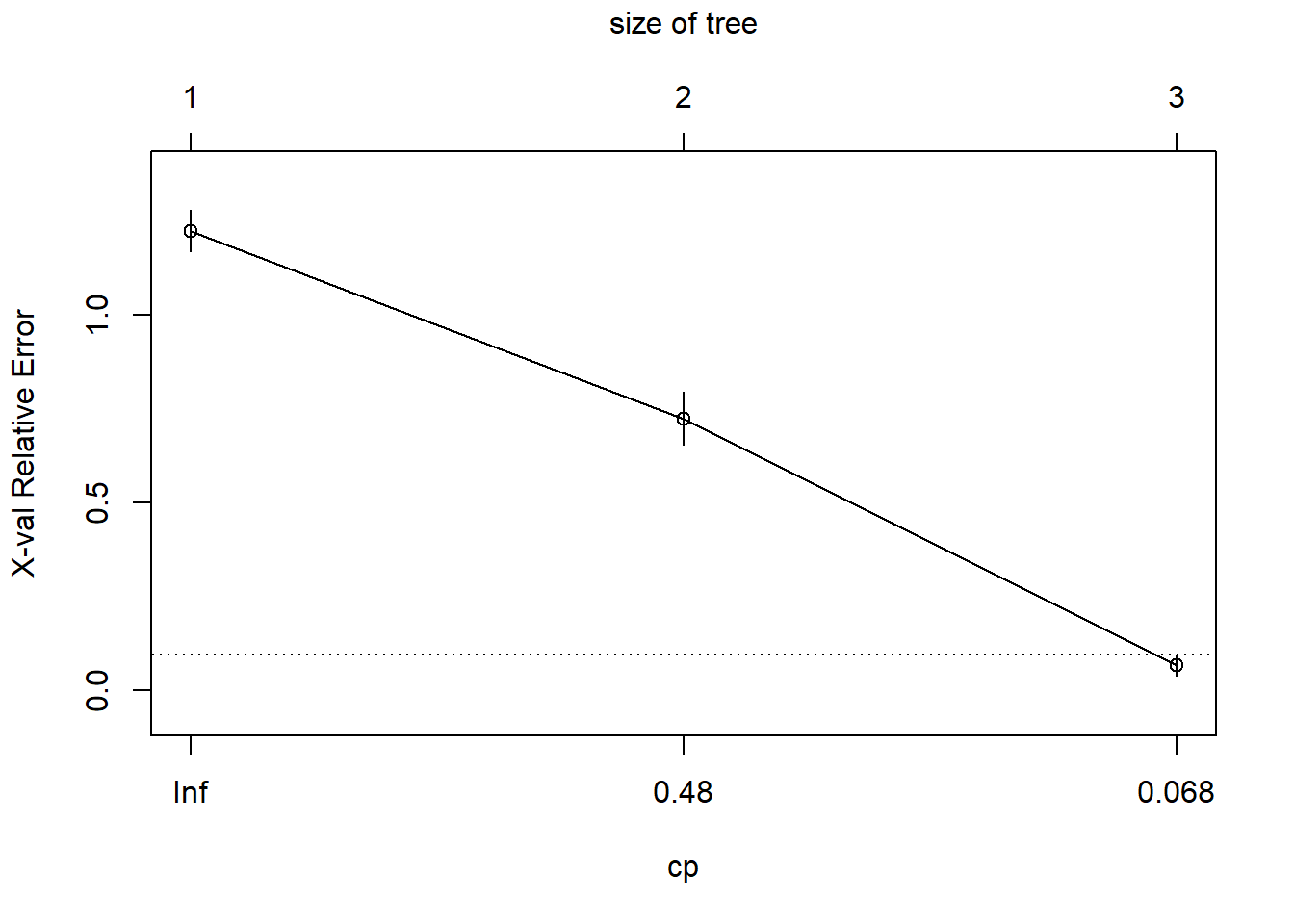
Teaching notes: explain cp (complexity parameter), minsplit, maxdepth, and how pruning works. Use printcp(fit_rpart) and plotcp(fit_rpart) to choose cp.
printcp(fit_rpart)
Classification tree:
rpart(formula = Species ~ ., data = train, method = "class",
    control = rpart.control(cp = 0.01))

Variables actually used in tree construction:
[1] Petal.Length

Root node error: 76/114 = 0.66667

n= 114

       CP nsplit rel error   xerror     xstd
1 0.50000      0  1.000000 1.223684 0.054461
2 0.46053      1  0.500000 0.723684 0.070201
3 0.01000      2  0.039474 0.065789 0.028769
plotcp(fit_rpart)
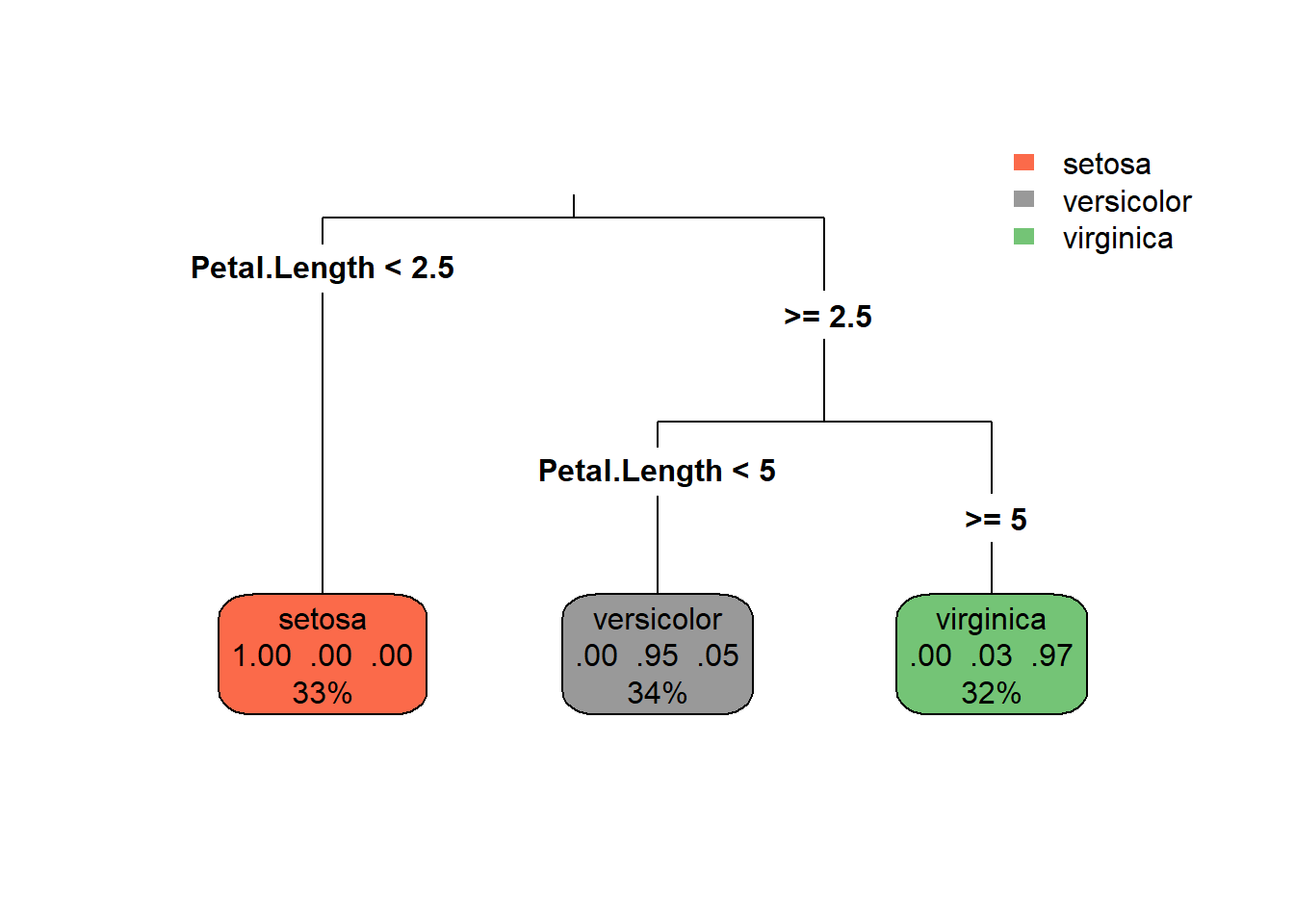
# prune to the cp with lowest xerror or the 1-SE ruleopt_cp <- fit_rpart$cptable[which.min(fit_rpart$cptable[,"xerror"]), "CP"]fit_pruned <-prune(fit_rpart, cp = opt_cp)rpart.plot(fit_pruned, type =3, extra =104)
3.5 4. Cross-validation and tuning with caret
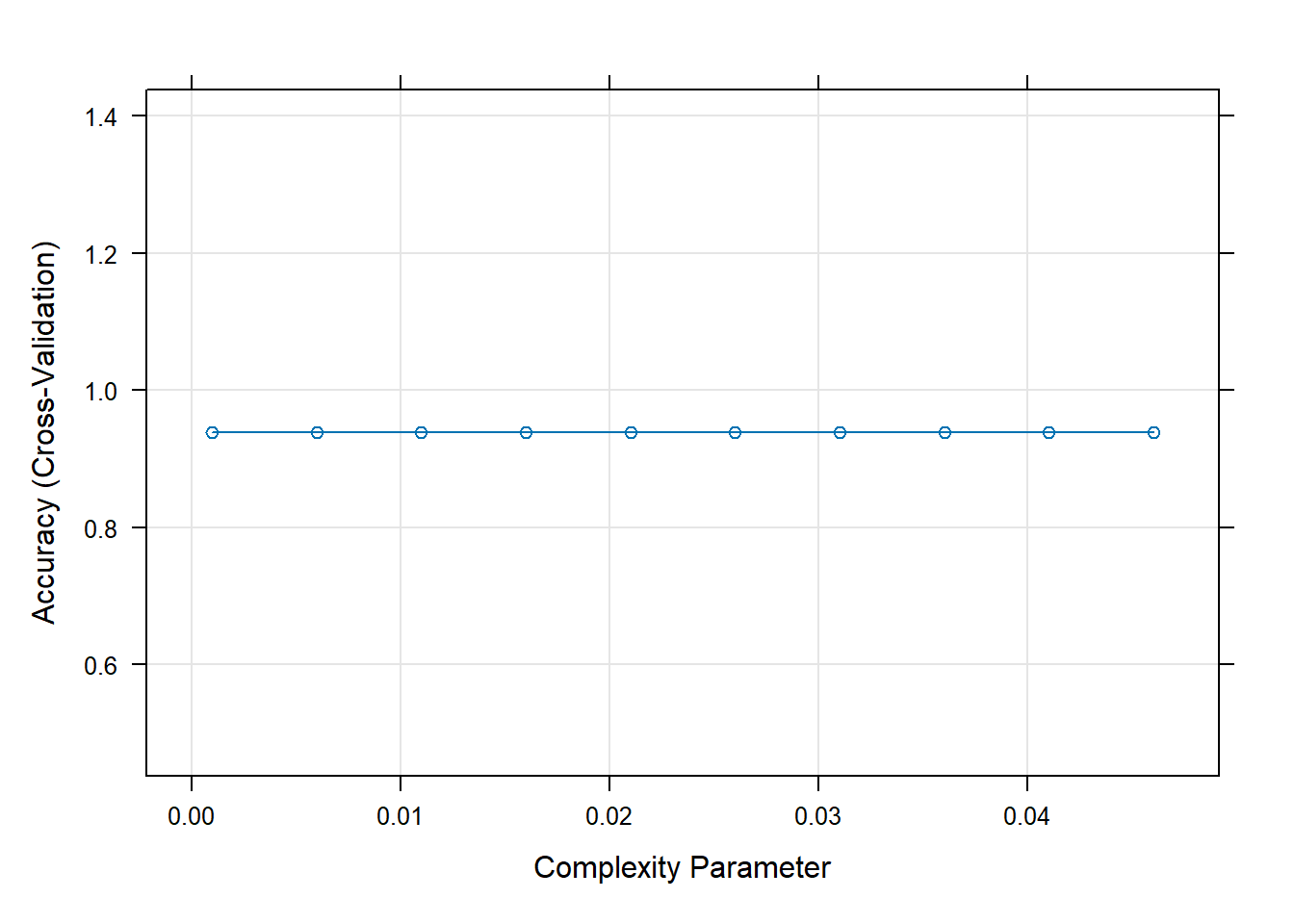
ctrl <-trainControl(method ="cv", number =5, classProbs =TRUE, summaryFunction = multiClassSummary)set.seed(42)tune_grid <-expand.grid(cp =seq(0.001, 0.05, by =0.005))caret_rpart <-train(Species ~ ., data = train, method ="rpart", trControl = ctrl, tuneGrid = tune_grid)caret_rpart
Discuss how importance is computed (split improvement) and limitations.
3.7 6. Partial Dependence Plots (PDPs)
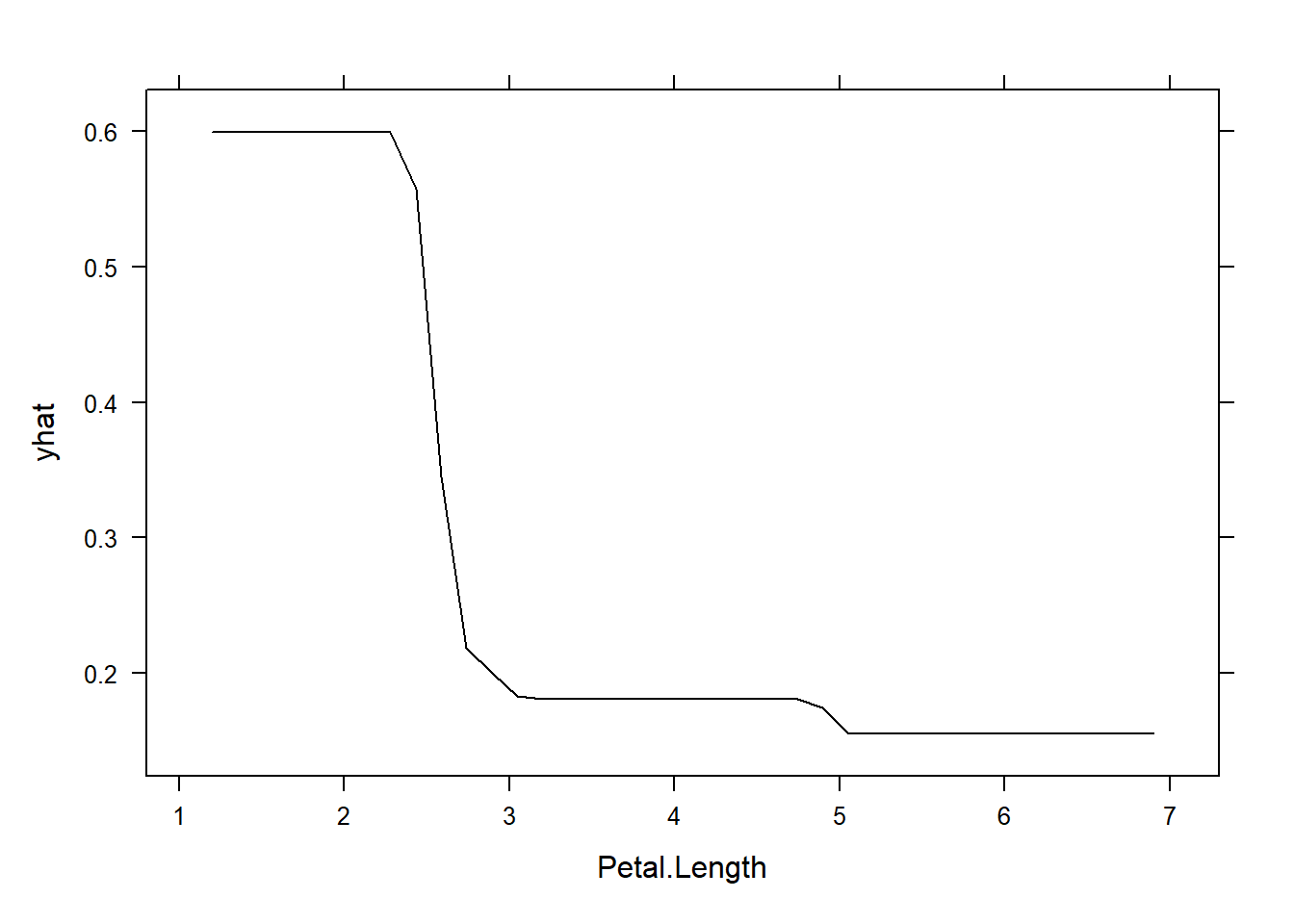
Goal: show marginal effect of a feature on predicted probability (or prediction) while averaging out other features.
3.7.1 6.1 PDP with pdp
# Use the caret-trained model (wrap predict function if necessary)# pdp works with models that have a predict method returning probabilities. We'll use the randomForest wrapper as an example.rf <-randomForest(Species ~ ., data = train)# Partial dependence for Petal.Length vs class setosa (probability)pdp_pl <-partial(rf, pred.var ="Petal.Length", plot =TRUE, prob =TRUE, which.class ="setosa")print(pdp_pl)
3.7.2 6.2 PDP with DALEX
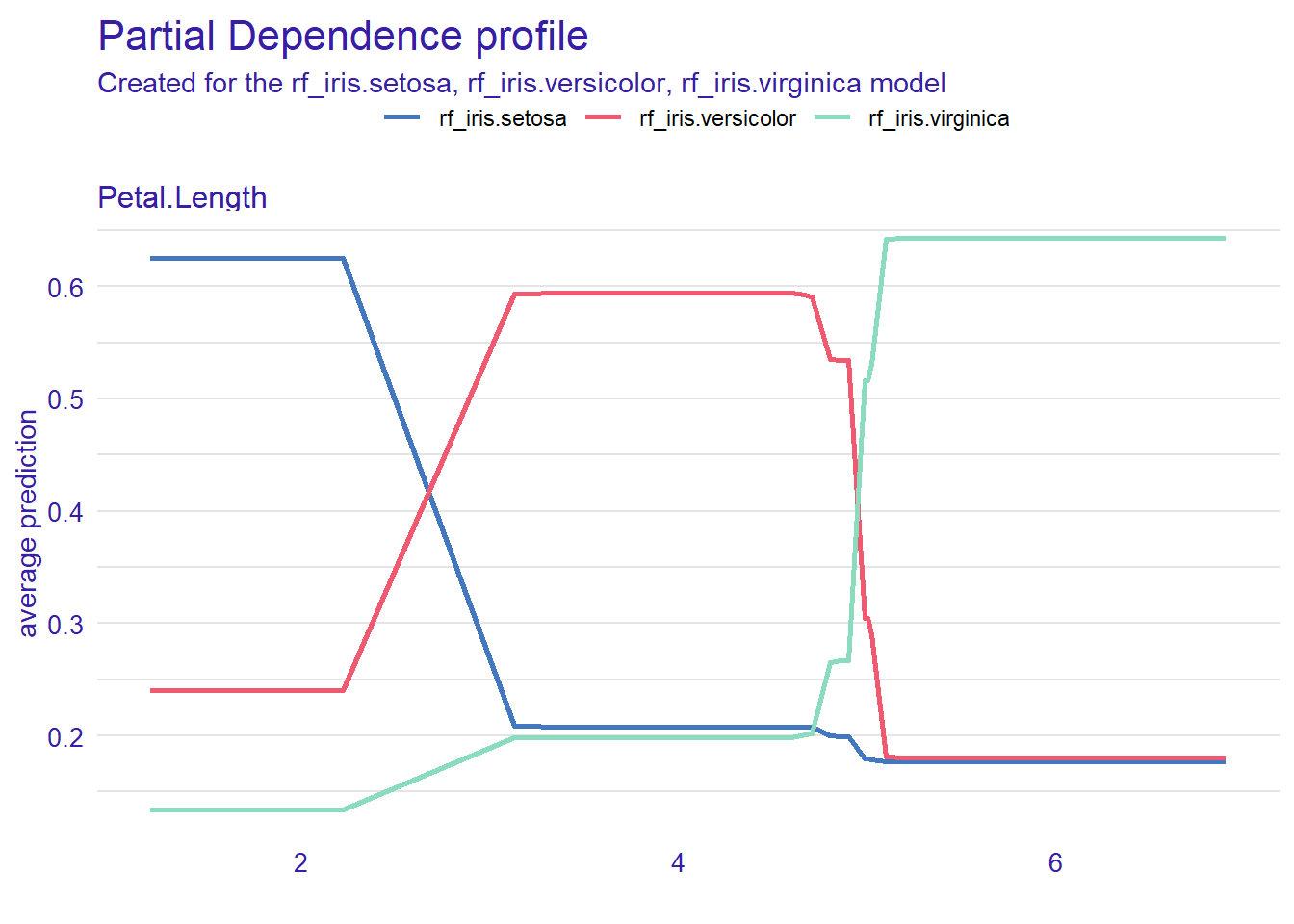
# Create an explainerexplainer_rf <-explain(rf, data = train[,1:4], y = train$Species, label ="rf_iris")
Preparation of a new explainer is initiated
  -> model label       :  rf_iris
  -> data              :  114  rows  4  cols
  -> target variable   :  114  values
  -> predict function  :  yhat.randomForest  will be used (  default  )
  -> predicted values  :  No value for predict function target column. (  default  )
  -> model_info        :  package randomForest , ver. 4.7.1.1 , task multiclass (  default  )
  -> predicted values  :  predict function returns multiple columns:  3  (  default  )
  -> residual function :  difference between 1 and probability of true class (  default  )
  -> residuals         :  numerical, min =  0 , mean =  0.01891228 , max =  0.34
  A new explainer has been created!
# Profile (partial dependence) using DALEXp <-model_profile(explainer_rf, variables ="Petal.Length", N =50)plot(p)
Teaching caveats: PDPs show average marginal effects and can be misleading with strong feature interactions. Use two-way PDPs or ICE plots for heterogeneity.
3.8 7. Individual Conditional Expectation (ICE) and 2D PDPs
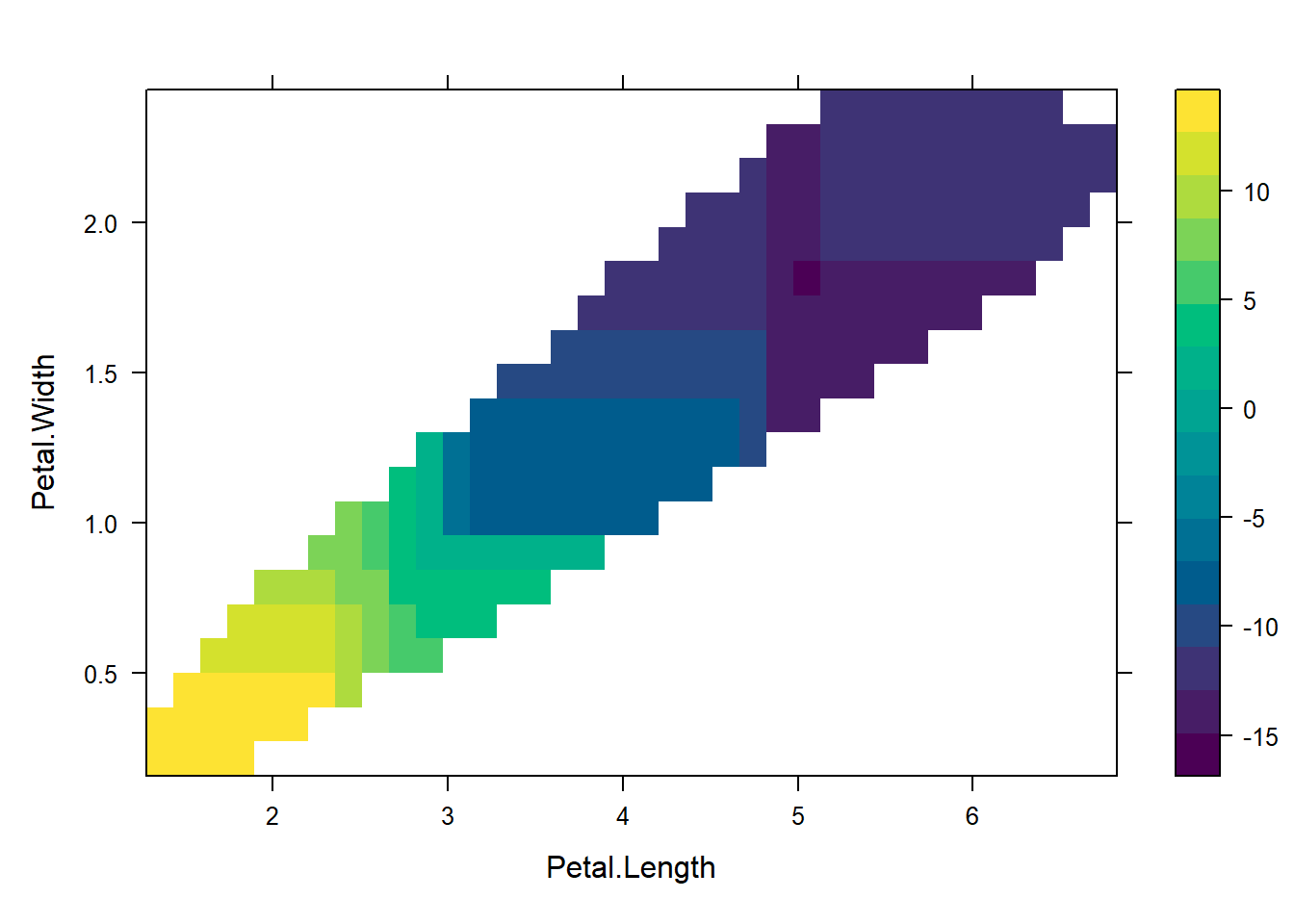
# ICE using pdpice_pl <-partial(rf, pred.var ="Petal.Length", ice =TRUE, plot =TRUE, which.class ="setosa")# 2D PDP for Petal.Length and Petal.Widthpdp_2d <-partial(rf, pred.var =c("Petal.Length", "Petal.Width"), chull =TRUE)plotPartial(pdp_2d)
3.9 8. Model comparison: Decision Tree vs Random Forest
# Fit Random Forest and comparerf_fit <-randomForest(Species ~ ., data = train)pred_rf <-predict(rf_fit, test)cm_rf <-confusionMatrix(pred_rf, test$Species)cm_tab <-rbind(tree = cm$overall[names(cm$overall) =="Accuracy"], rf = cm_rf$overall[names(cm_rf$overall) =="Accuracy"])cm_tab
      Accuracy
tree 0.8611111
rf   0.9444444
Discuss trade-offs: interpretability (tree) vs performance (RF), stability, and overfitting.
3.10 9. Automated tests for classroom (sanity checks)
# 1) Ensure tree predictions have reasonable accuracy (> 0.7 on iris test)acc_tree <- cm$overall["Accuracy"]stopifnot(acc_tree >=0.7)# 2) PDP returns a data.frame and includes Petal.Length valuespdp_res <-partial(rf, pred.var ="Petal.Length", prob =TRUE, which.class ="setosa", plot =FALSE)stopifnot(is.data.frame(pdp_res))stopifnot("Petal.Length"%in%names(pdp_res))list(tests ="all passed", tree_accuracy = acc_tree)
$tests
[1] "all passed"

$tree_accuracy
 Accuracy
0.8611111
3.11 10. Exercises and in-class tasks
Exercise A: Build and prune a decision tree on the wine or iris dataset; show how pruning affects depth and accuracy.
Exercise B: Compute PDPs for two top features in a caret-tuned model and interpret whether they are monotonic or have thresholds.
Exercise C (advanced): Use iml to compute Shapley values for a small set of observations and compare with PDP insights.
End of Module 2 — Decision Tree Analysis & Partial Dependence